
Microchip PIC16F1718-I/ML Microcontroller: Features, Architecture, and Application Design Guide
The Microchip PIC16F1718-I/ML stands as a versatile 8-bit microcontroller within the enhanced mid-range PIC16F171 family. Housed in a compact 28-pin QFN (5x5mm) package, this device is engineered for a wide array of embedded control applications, offering a powerful blend of core independent peripherals (CIPs), analog integration, and low-power operation. This guide delves into its key features, architectural overview, and essential design considerations.
Key Features and Capabilities
The PIC16F1718 is built around an enhanced mid-range core with a 16-level deep hardware stack and 49 instructions. Its standout characteristics are its highly integrated and intelligent peripherals.
Core Independent Peripherals (CIPs): A defining feature of this MCU is its suite of CIPs that operate without constant CPU intervention, boosting system performance and efficiency. Key CIPs include:
Complementary Waveform Generator (CWG): Outputs complementary PWM signals with dead-band control, ideal for driving half-bridge and full-bridge circuits in motor control and power conversion.
Windowed Watchdog Timer (WWDT): A configurable watchdog timer that can trigger an interrupt or reset based on a specific "window" of time, enhancing software reliability.
Hardware Limit Timer (HLT): Provides a hardware-based safety shutdown for PWM outputs, crucial for protecting power electronics in fault conditions.
Advanced Analog Integration: The microcontroller incorporates a rich set of analog peripherals, reducing the need for external components.
12-bit ADC with Computation (ADC²): This advanced ADC can perform accumulation, averaging, and low-pass filtering in hardware, allowing the CPU to sleep while data is being processed, significantly saving power.
8-bit Digital-to-Analog Converter (DAC): Features two 8-bit DAC modules (DAC1 and DAC2), useful for generating reference voltages or analog waveforms.
Comparator (COG) with Programmable Voltage Reference: Two comparators with flexible input selection and hysteresis control.
Communication Interfaces: It supports essential serial communication protocols, including I²C, SPI, and EUSART (Enhanced Universal Synchronous Asynchronous Receiver Transmitter), facilitating easy connection to sensors, memories, and other peripherals.
Memory: It boasts 14 KB of Flash program memory, 1024 bytes of RAM, and 256 bytes of non-volatile EEPROM data memory.
Architectural Overview
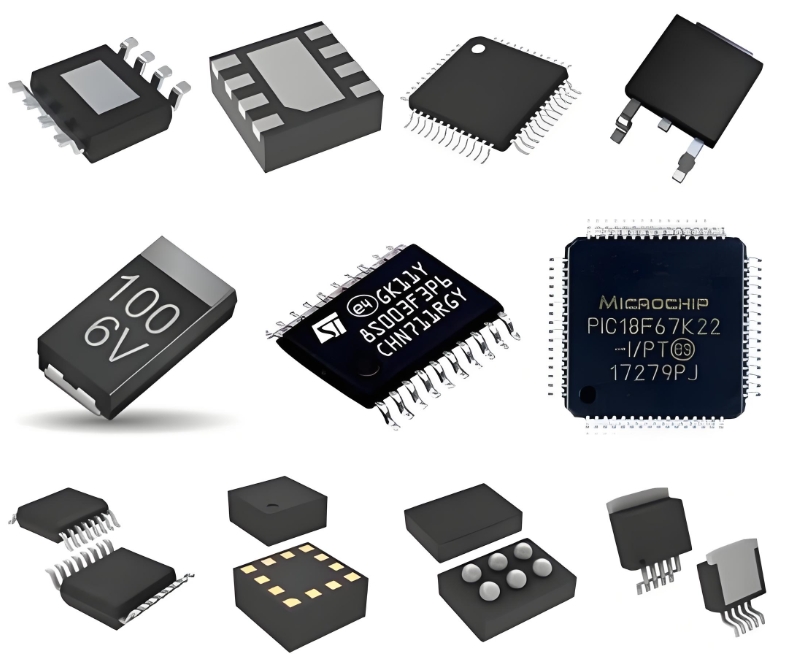
The architecture of the PIC16F1718 is Harvard-based, with separate program and data buses, enabling full-speed execution. The enhanced mid-range core includes a vector interrupt controller for efficient handling of peripheral interrupts. The peripheral pin select (PPS) feature allows for the digital remapping of I/O pins, offering exceptional flexibility in board layout and design. This means functions like UART or PWM can be assigned to multiple different pins, simplifying PCB routing.
Application Design Guide
Designing with the PIC16F1718-I/ML requires a methodical approach to leverage its full potential.
1. Power Supply and Decoupling: Ensure a stable and clean power supply. Place 100nF decoupling capacitors as close as possible to the VDD and VSS pins of the QFN package to filter high-frequency noise.
2. Clock Configuration: Choose an appropriate clock source (e.g., internal HF oscillator, external crystal) based on the required accuracy and power consumption of your application. Configure the oscillator bits in the configuration registers accordingly.
3. Peripheral Configuration: Utilize Microchip's free MPLAB® X IDE with the XC8 compiler for code development. Leverage MPLAB Code Configurator (MCC), a graphical plugin, to generate initialization code and drivers for complex peripherals like the ADC², CWG, and DAC. This drastically reduces development time.
4. Analog Design: When using the ADC, ensure the analog input signal is within the VREF- and VREF+ range. Use the internal fixed voltage reference (FVR) for a stable ADC or DAC reference. Proper grounding is critical; separate analog and digital grounds and tie them together at a single point.
5. Thermal Management (for QFN): The QFN package relies on the exposed thermal pad for heat dissipation. Connect this pad to a grounded copper pour on the PCB with multiple vias to act as a heat sink, especially in high-current drive applications.
6. Debugging: The PIC16F1718 supports In-Circuit Serial Programming™ (ICSP™) and debugging. Plan for a standard 6-pin ICSP header in your design for programming and debugging.
The Microchip PIC16F1718-I/ML is a highly integrated and capable 8-bit microcontroller. Its standout combination of Core Independent Peripherals (CIPs), advanced analog features like the 12-bit ADC with Computation, and communication flexibility make it an excellent choice for complex control applications such as motor control, power supplies, industrial automation, and sophisticated sensor interfaces. Its QFN package offers a compact footprint for space-constrained designs.
Keywords:
1. Core Independent Peripherals (CIPs)
2. Complementary Waveform Generator (CWG)
3. ADC with Computation (ADC²)
4. Peripheral Pin Select (PPS)
5. QFN Package

